For Reception and Key Stage 1 · Free to your school
Children see the tap.
Help them see the choice.
A seven-week, story-led money programme for one class of 4 to 7 year olds. We deliver the opening Spark Session, your teacher runs six short weekly cards, and a local business pays for the classroom. No child is ever asked about money at home.
Autumn 2026 dates are open. One school per date. Nathan confirms within one working day.

Why this exists
“It’s OK, Daddy. Just tap it.”
My daughter said that to me in a shop, on a family holiday. I had worked in financial services for nearly twenty years, and that sentence stopped me where I stood.
She wasn’t being greedy. She was being logical. She could see the phone, hear the beep and see the thing we walked out with. What she couldn’t see was money leaving, or the choice underneath it.
Money used to be visible. A child watched coins leave a purse and change come back. Now the exchange happens behind a beep. Pocket Money Adventures exists to make that choice visible again, in the classroom, at the age the foundations form.
Nathan WaldronFounder, Designated Safeguarding Lead, and dad of two
September 2028 is coming
Following the Curriculum and Assessment Review, citizenship becomes statutory at key stages 1 and 2, with financial education inside it. First teaching is expected in September 2028. The programme of study isn’t published yet, so nobody can say their scheme already meets it, us included. Starting now gives your staff a head start.
Why four to seven
A review commissioned by the Money Advice Service concluded that the cognitive foundations of later financial behaviour are typically in place by around age seven.
The limit: a review of developmental research, not a study of any programme. Whitebread and Bingham, 2013.Why the money is harder to see
A 2024 meta-analysis of 71 papers found a small but reliable tendency to spend more when paying by card or phone than with cash.
The limit: adults, and the effect is small. Schomburgk, Belli and Hoffmann, Journal of Retailing, 2024.What the children learn
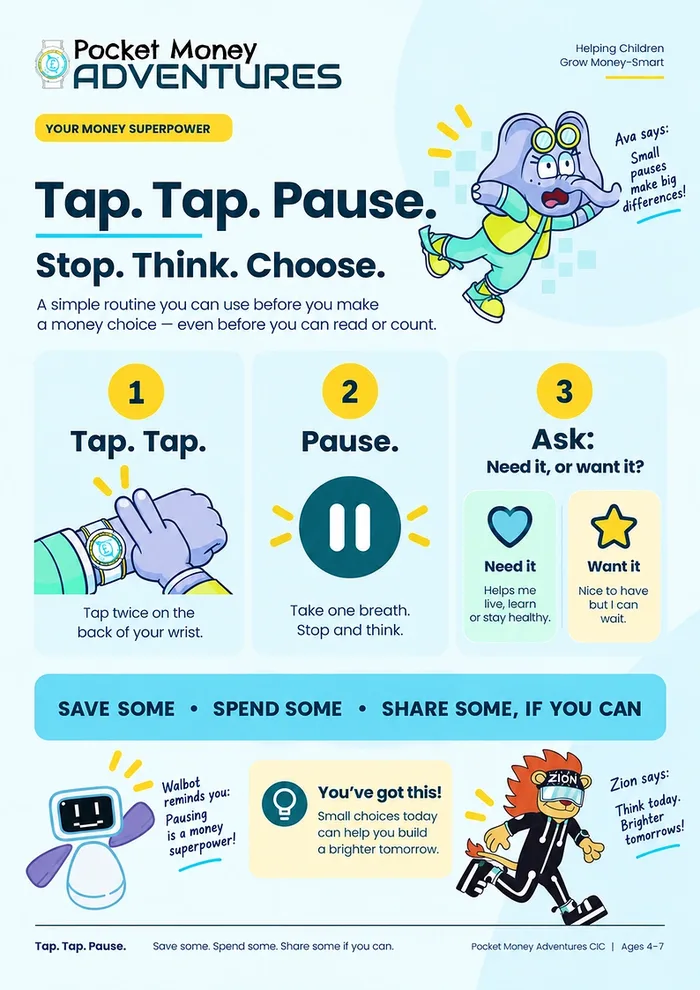
One routine a four year old can do. Tap, Tap, Pause.
Tap.
Tap once and ask, “Do I need it, or do I want it?”
Tap again.
Ask, “If I get it now, what can’t I get later?”
Pause.
One breath, then choose.
Give a reason.
The reason is the point, not the answer. A child who says “it depends, because…” has done the work.
Every situation belongs to a story character. Core participation doesn’t depend on confident reading, writing or calculation. Prefer not to tap? A breath or a pause card works too.
How it works
Seven weeks. One visit from us.
If a headteacher only has two minutes, this is the part to read. If a week doesn’t run, it’s logged as missed and nothing needs catching up.
The Spark Session
60 to 75 minutes in your classroom, with the carpet or hall as space. A story, a poster and the routine. Your teacher stays in the room and presents nothing.
- Welcome, routine, needs and wants
- Save some, spend some, share some if you can
- The book, draw and choose, close
Six Sidekick Cards
One card a week, 1 to 5 minutes. Pick it up and read it. No printing, no slides, no marking.
A two-minute check-in each week, on a phone if easier. Week 7 ends with a recall check, then your Delivery and Learning Report and the certificates.
The Home Link
Four optional Family Missions and a Parent Fridge Card that stays up all term.
Nothing to fill in, return, buy or prove. Nobody is asked in class who did it. A family that does none of it costs their child nothing.
Your teacher
Present, not presenting
- About 15 minutes a week, with no more than five minutes of prep
- About 10 minutes of setup before Week 1, once
- This is a design figure. Your check-ins tell us the real one
Your pupils
A story, then a routine
- They meet Ava and Walbot in their own classroom
- Nobody is tested and nobody is compared
- Every child keeps a certificate with their name on it
Your families
Optional, always
- The same words the class used, carried home
- No question about what a family earns, spends or can’t afford
- Nothing comes back to school
What your school gets
Everything is included.
A local business pays for your classroom. If we can’t match a sponsor to your class, we tell you within four weeks of signing. The programme doesn’t run, and your school owes nothing.
- A Spark Session delivered by us, 60 to 75 minutes
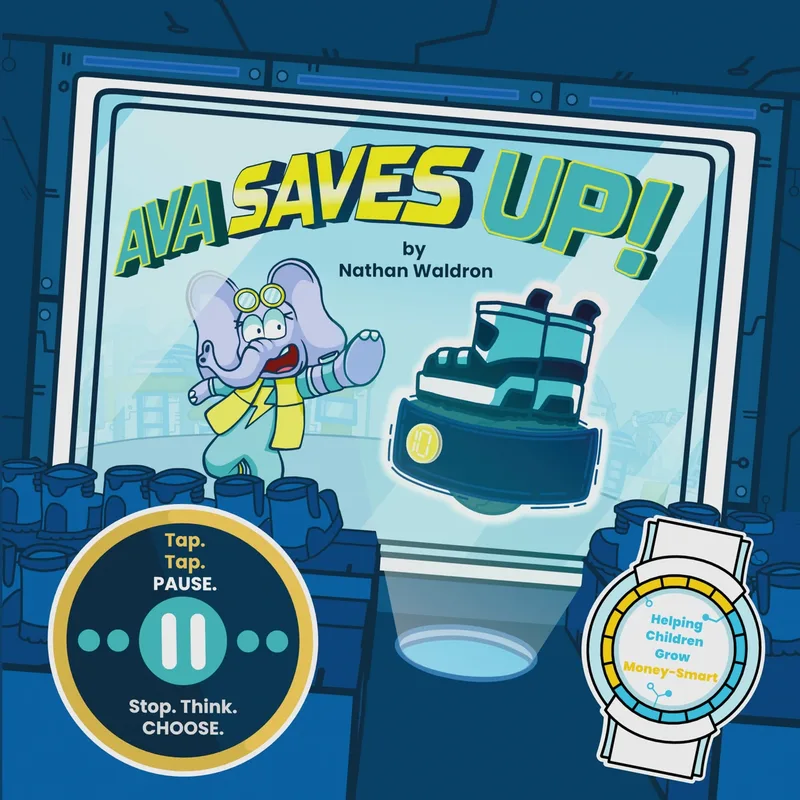
- A set of Ava Saves Up! books for the class library
- An A2 Tap, Tap, Pause classroom poster
- Teacher Sidekick Cards for the weekly routine
- A Parent Fridge Card for every child
- Four Family Missions for weeks 1 to 4
- A shared teacher page for weekly check-ins
- A Delivery and Learning Report, with the awkward rows left in
- A certificate for every child on roll, and one for the classroom wall
- A short prep call with your class teacher
- Optional Booster Sessions through the year
- The full policy pack and ongoing support
The evidence, honestly
We’d rather show you the ladder than a percentage.
Story-led classroom delivery ran in summer 2026 in Stoke-on-Trent and Staffordshire schools. The full seven-week pathway hasn’t yet completed an end-to-end cycle, so an early school is among the first to run it. Your classroom feeds a designed evidence base, not a testimonial.
What we say
- Summer 2026 delivery gives small formative evidence that the session can be delivered in practice
- Current evidence supports feasibility, engagement, and classroom recall and demonstration
- Teachers reported children using the routine without being asked. A useful informal indication, and labelled as one
- The 2026 to 2027 pilot measures one primary outcome: do children pause before deciding, without the routine being named
What we refuse to say
- Proven, evidence-based, Ofsted-ready, or anything about an inspection judgement
- That the routine has become a habit or a reflex
- That it changes real-world money behaviour or protects a child from debt later
- Any percentage of children. Our measures rate a class, never a child
A full pack is under Financial Education Quality Mark assessment with Young Enterprise. Nothing has been awarded, and until it is, we don’t describe the programme as quality marked, accredited or approved.
Safeguarding, data and the sponsor
Everything a headteacher checks before saying yes.
Safeguarding
Designated Safeguarding Lead Nathan Waldron, Deputy DSL Bernadette Houlton. Delivery happens under your visitor procedures, and the school keeps responsibility.
Enhanced DBS
Anyone delivering holds an enhanced DBS check with the children’s barred list check, on the Update Service.
Never alone with a child
A teacher stays in the room throughout. No photography of children unless your school agrees it in writing first.
Children’s data
No child is named in any context. All reporting is class-level. Registered with the ICO, ZC124930.
The sponsor
Acknowledged to adults, in wording your school approves in advance. No product promotion reaches children, and the sponsor gets no access to families or data.
Insured and registered
Public liability insurance in place. A UK Community Interest Company, No. 16994988. We send the policy suite the day you ask.
Booking takes two minutes
Pick a date. We’ll do the rest.
Choose a date
Autumn term dates are live. Each date goes to one school.
Tell us about your class
A short form: school, year group, class size.
Nathan confirms
Within one working day, with a time agreed on a short call.
Spark Session
We arrive with the story, the poster and the books.
For your governors and SLT
The detail, ready to share.
Read the full School Pathway
Week-by-week detail, specimen reports, the evidence table and our corrections. Version 1.6, 8 September 2026.


Autumn 2026 dates are open.
Free to your school, funded by a local business, and delivered in your own classroom. Dates go one school at a time.
Book a Spark Session